
PCL
PCL Injury Treatment in Jaipur
Expert Care by Dr Sachin Sharma (Pachori) – PCL Specialist In Jaipur
What is the PCL (Posterior Cruciate Ligament) ?
PCL is a strong ligament that is inside the knee joint. PCL connects the femur, which’s the thigh bone to the tibia, which is the shin bone.
The PCL plays an important role in keeping the knee stable. It does this by stopping the tibia from moving which is a big deal, for the knee.
The PCL works with other ligaments, like the ACL to help us move our knee smoothly when we are walking, running, bending and doing sports. If the PCL gets hurt it can be hard to balance. It can affect how our knee works. So we need to see a PCL Specialist In Jaipur who knows what they are doing to check our PCL and help us feel better.

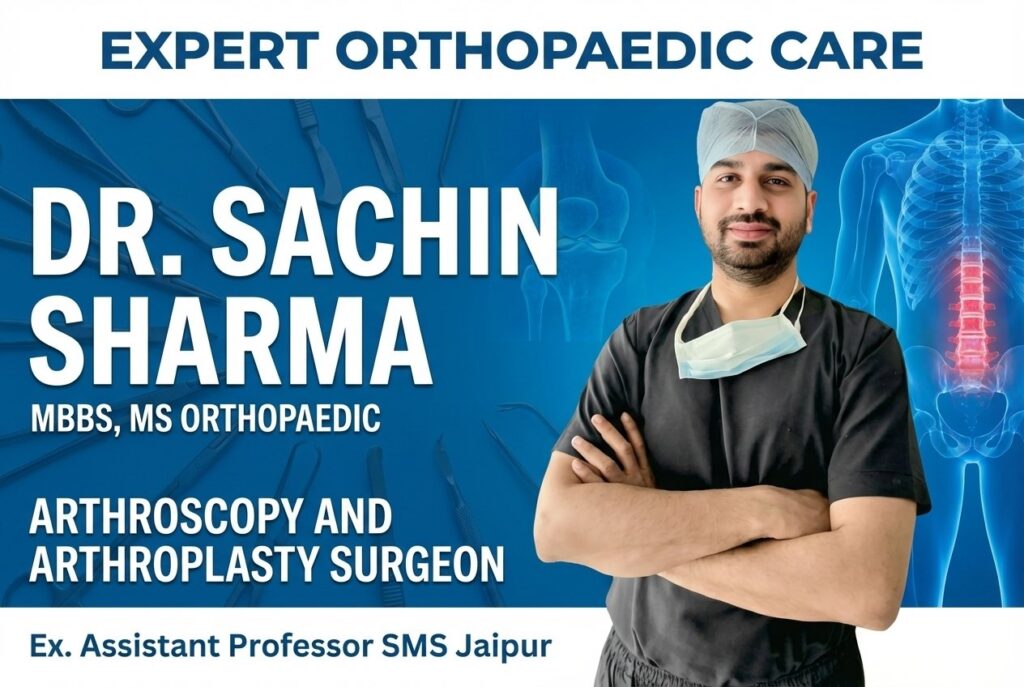
Dr Sachin Sharma, who is also known as Dr Sachin Kumar Pachori is a doctor that people trust to fix PCL problems in Jaipur. He does a thorough check to figure out what is wrong with PCL injuries and then uses the latest methods to treat them. Dr Sachin Sharma is a PCL Specialist Doctor In Jaipur. He is very good, at taking care of PCL injuries.
What causes a PCL injury?
A PCL injury is usually caused by a blow to the front of the knee.
This kind of thing can happen when the knee hits the dashboard in a car accident etc.
A PCL injury can also happen when someone falls on a knee.
The PCL can also get hurt when someone jumps and lands wrong.
Sometimes a Posterior Cruciate Ligament injury can happen when the knee gets twisted.
This can cause the Posterior Cruciate Ligament to tear.
A Posterior Cruciate Ligament injury is a serious thing.
The PCL plays a role, in keeping the knee stable.
So when the PCL gets hurt it can be very painful.
People who get a PCL injury usually need to visit a doctor.
People get PCL injuries when something hits their knee hard or when they experience a lot of force on their knee. Some things that can cause PCL injuries are:
Car accidents
Sports injuries
Falling on a bent knee
Sudden twisting or forceful knee movements
If you have knee pain after something bad happens to you or you get hurt playing sports you should go see a PCL Specialist In Jaipur. This is an idea because it can help stop you from having big problems, with your knee for a long time. The PCL Specialist In Jaipur can help you feel better and make sure your knee is okay.
Symptoms of a PCL Injury
The symptoms of ligament damage can be different, for each person. It really depends on how bad the damage’s. Some common things people notice include:
Knee pain and swelling
Feeling of knee instability
Difficulty walking or running
Pain while bending or climbing stairs
Stiffness in the knee joint
If you have symptoms that just will not go away you should do something about it. You should go see a PCL Specialist Doctor In Jaipur soon as you can. This doctor is qualified. Can help you figure out what is going on with your body. The sooner you see the PCL Specialist Doctor In Jaipur the sooner you can get the treatment and start feeling better. Going to see a PCL Specialist Doctor In Jaipur, on is very important.
How is a PCL Injury Identified?
Getting the diagnosis right is really important, for figuring out the treatment plan. The evaluation will include:
Detailed physical examination by an orthopedic specialist
X-ray to rule out fractures
I need to get an MRI scan to see if I really hurt my ligaments and to find out how bad the injury is. The MRI scan will confirm if I have a ligament injury and it will also assess the severity of the ligament injury.
At our center Dr Sachin Sharma uses imaging and he is very good at what he does. He provides an accurate diagnosis. Dr Sachin Sharma is a leading PCL Specialist In Jaipur. He makes sure that the treatment is just right, for each patient. The treatment depends on how bad the injury’s what kind of activities the patient likes to do.
Treatment Options for PCL Injury:
Comprehensive Care by PCL Specialist Doctor In Jaipur
Non-Surgical Treatment
Mild to moderate PCL injuries can often be managed without needing an operation. The treatment, for PCL injuries may include:
Rest and activity modification
Use of a knee brace for support
Guided physiotherapy and strength training
Pain relief medications
The doctors keep an eye on the non-surgical management. They do this to help get the knee strong. They also want to prevent the knee from becoming unstable. This is important for the knee to feel better and work properly. Non-surgical management is used to restore knee strength and prevent knee instability.
Surgical Treatment
The doctor may say that surgery is an idea, in these situations:
Severe PCL tears
Persistent instability
Combined ligament injuries
There are some options that people can consider. These surgical options include:
PCL reconstruction surgery
Minimally invasive arthroscopic techniques
Modern fixation implants
Structured post-operative rehabilitation
Patients get the treatment from Dr Sachin Sharma, a well known specialist in Jaipur. He is very good at doing operations with a tool called arthroscope. Dr Sachin Sharma makes sure that people who come to him get the care so that they can recover fully. People trust Dr Sachin Sharma because he is an expert, in this field.
Recovery and Rehabilitation
The recovery process is really, about how bad the injury is and what kind of treatment the injury gets. If the injury is very bad the recovery will take some time. If the injury is not bad then the recovery will be faster.Injury and Treatment method are two things that affect the recovery.
Rehabilitation through physiotherapy and Stretching is very important to restore muscle strength, joint flexibility, and functional mobility after an injury. Physiotherapy is the key, to regaining our strength and motion.
Most patients are able to get to their normal daily activities within three to six months. They can usually do everything they used to do. The patients can go back, to work. Do things they like within this time. Most patients return to their daily activities within this time frame of three to six months.
Athletes need time to get better when they are hurt. The time it takes for athletes to recover is usually longer, than usual. Athletes have to make sure that they are completely recover before they start playing there games.
Regular follow-up with your PCL Specialist Doctor In Jaipur ensures safe recovery
A good rehabilitation program really helps with knee stability and how well your knee works over time. This kind of program makes a difference in how strong and steady your knee is. A structured rehabilitation program is very important, for knee stability and long-term function.
You should go see a doctor when you are really sick.
When your body is not feeling good and you do not know what is wrong with your health you should see a doctor.
You should see a doctor when you have an injury or when you are in a lot of pain.
The doctor can help you figure out what is wrong, with your health and give you the treatment to make you feel better.
You should see a doctor to get a check up and make sure your health is good even when you are not sick.
The doctor is there to help you with your health. You should see a doctor when you need help with your body.
You should go see a PCL Specialist In Jaipur if you have problems like
* pain, in your knee
* your knee is not stable
* you have a time walking
* you feel like your knee is going to give way
You should see a PCL Specialist In Jaipur for these issues.
Persistent knee pain or swelling
Knee instability or “giving way”
Difficulty performing daily activities
Knee injury after accident or sports activity
Getting a diagnosis early, on really helps people get better. It stops knee problems from becoming long term issues. Early Assessment of knee problems is very important because it improves recovery outcomes and prevents knee problems.
Why Choose Dr Sachin Sharma (Pachori) for PCL Treatment?
Experienced orthopedic and ligament specialist
Advanced diagnostic and imaging facilities
Personalized treatment planning
Modern techniques of arthroscopic surgeory
Evidence-based rehabilitation protocols
Patient care
Patient follow-up
FAQ
What is the Posterior Cruciate Ligament (PCL)?
The Posterior Cruciate Ligament (PCL) is one of the four major ligaments of the knee. It connects the thigh bone (femur) to the shin bone (tibia) and helps keep the knee stable by preventing the tibia from moving backward.
Where is the PCL located?
The PCL is located inside the knee joint, at the back of the knee. It works together with the Anterior Cruciate Ligament (ACL) to control forward and backward movement of the knee.
Can a person walk with a PCL tear?
Yes, many people can walk with a PCL tear, but they may experience pain, swelling, or instability, especially during physical activities.
What causes a PCL injury?
A PCL injury usually occurs due to a strong impact on the front of the knee when it is bent. This commonly happens in road traffic accidents, sports injuries, or falls. Athletes involved in football, cricket, basketball, or skiing are at higher risk. In some cases, PCL injuries can occur along with other ligament injuries.
What are the symptoms of a PCL injury?
Symptoms of a PCL injury may include knee pain, swelling, stiffness, and difficulty walking. Some patients experience a feeling of instability or weakness in the knee, especially while going downstairs or running. In mild cases, symptoms may be minimal and develop gradually over time.