
Total Hip Replacement
What is Total Hip Replacement?
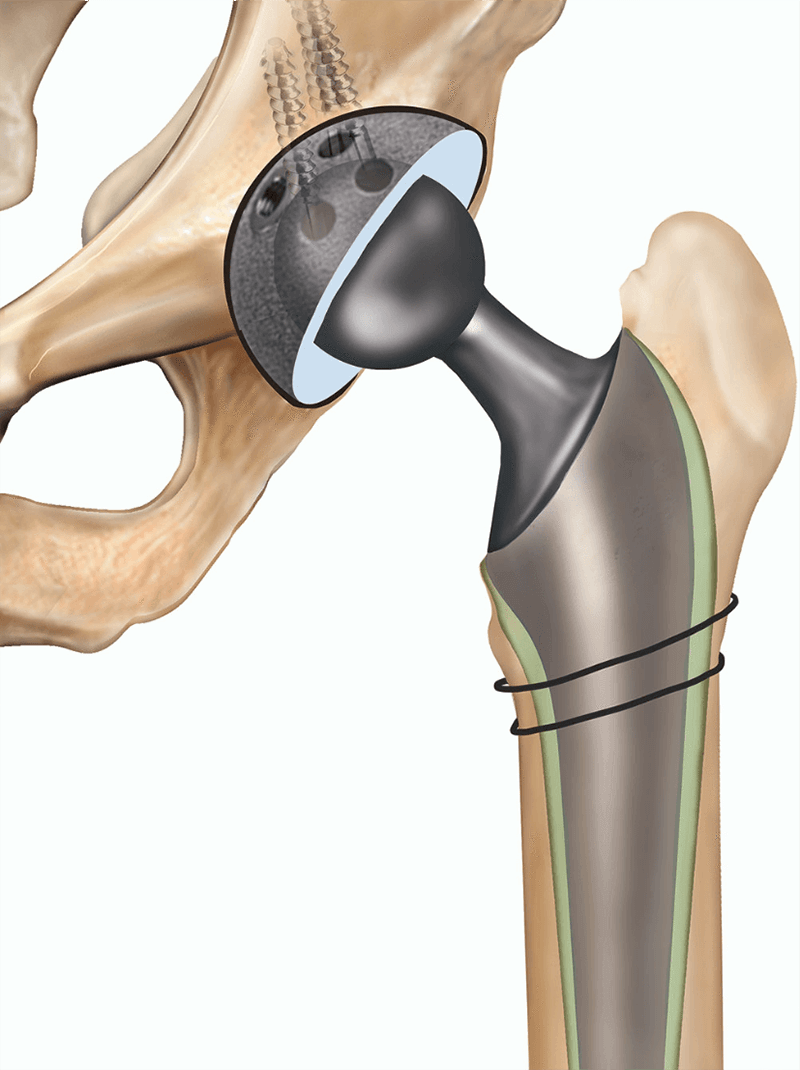
Total Hip Replacement (THR), also known as Total Hip Arthroplasty, is a surgical procedure in which a damaged or diseased hip joint is replaced with an artificial implant (prosthesis). The artificial joint is designed to reduce pain, improve mobility, and help patients return to an active, pain-free lifestyle.
When is Total Hip Replacement Needed?
THR is usually recommended when hip pain and stiffness significantly affect daily activities and do not improve with non-surgical treatments.
Common conditions include:
Osteoarthritis of the hip
Rheumatoid arthritis
Avascular necrosis (loss of blood supply to the hip bone)
Hip fractures
Severe hip injury or deformity
Chronic hip pain with limited movement
Symptoms That May Require THR
Persistent hip or groin pain
Pain while walking, sitting, or climbing stairs
Stiffness and reduced range of motion
Difficulty standing or walking for long periods
Pain that does not improve with medication or physiotherapy
Types of Hip Replacement
Total Hip Replacement – Both the ball and socket are replaced
Partial Hip Replacement – Only the femoral head (ball) is replaced
Cemented Hip Replacement
Uncemented Hip Replacement
Your orthopedic surgeon will recommend the best option based on age, bone quality, and activity level.
The THR Procedure
During the surgery:
The damaged hip joint is removed
The socket is replaced with an artificial cup
A metal or ceramic ball is placed on a stem inserted into the thigh bone
The new joint restores smooth movement
The surgery typically takes 1–2 hours.
Benefits of Total Hip Replacement
Significant pain relief
Improved mobility and flexibility
Better quality of life
Ability to walk and perform daily activities comfortably
Long-lasting results (15–20 years or more)
Recovery After Hip Replacement
Hospital stay: 2–4 days
Walking with support within 24–48 hours
Physiotherapy starts early for faster recovery
Most patients resume normal activities within 6–8 weeks
Full recovery depends on individual health and rehabilitation.
Risks and Complications
Although THR is a safe and commonly performed surgery, possible risks include:
Infection
Blood clots
Dislocation of the hip joint
Implant wear or loosening
Leg length difference
Your surgeon will discuss these risks before surgery.
Life After Total Hip Replacement
After recovery, most patients can:
Walk comfortably without pain
Perform daily activities easily
Return to low-impact activities like walking, swimming, and cycling
High-impact sports should be avoided unless advised by the surgeon.
Why Choose Us?
Experienced orthopedic surgeons
Advanced surgical techniques
Personalized treatment plans
Comprehensive rehabilitation support
High success rate in hip replacement surgeries
Book an Appointment
If you are suffering from hip pain or limited mobility, consult our orthopedic specialist to know if Total Hip Replacement is the right solution for you.
FAQ
Is arthroscopic ACL better than open surgery?
Yes, keyhole (arthroscopic) approaches generally allow reduced pain, earlier motion and faster recovery — though long-term stability depends on correct technique and rehabilitation.
Which ACL graft is the best?
- Bone–Patellar Tendon–Bone (BPTB) – Best choice for competitive athletes.
- Hamstring Tendon (Semitendinosus ± Gracilis) – Best for general population & non-contact sports.
- Quadriceps Tendon (± Bone Plug) – Excellent alternative to BPTB.
- Allograft (Cadaver Graft) – Avoid in young athletes
Do all ACL tears need surgery?
No. Partial tears or low-activity lifestyles may be managed without surgery. But persistent instability or pivoting sports favour surgical reconstruction.
When can I return to sport after ACL reconstruction?
Return to sport (RTS) after ACL reconstruction is based on function, not just time.
Returning before 6 months → 2–4× higher re-injury risk
Young athletes (<25 yrs) have highest re-tear risk
Rehab quality matters more than graft type
Minimum 9 months for pivot sports
What about meniscus injury along with ACL?
If your MRI shows a meniscus tear along with ACL injury, we prioritise meniscus repair or preservation to protect knee cartilage and longevity.